SWOT analysis template
Strengths, weaknesses, opportunities, threats: a SWOT analysis fits in a grid of four boxes. Two look inward, at what you control. Two look outward, at what happens to you.
A filled-in example
Strengths
- Loyal early users
- Fast updates
- Clean, simple design
3 items
Weaknesses
- Small marketing budget
- Not on Android yet
2 items
Opportunities
- Back-to-school season
- Press interest
2 items
Threats
- Big competitors
- Price war
2 items
When to use it
Before a strategic decision: launching a product, entering a market, changing careers. SWOT stands for Strengths, Weaknesses, Opportunities and Threats, and works just as well for a person as for a company.
- Launching a product or a service
- Testing a business idea
- Preparing a career change or an interview
- Taking stock of a team or a project
How to fill it in
- Strengths and weaknesses: what depends on you. Skills, resources, reputation, limits.
- Opportunities and threats: what comes from outside. Market, competition, timing, regulation.
- Stay concrete: “small marketing budget” says more than “lack of resources”.
- Then cross the boxes: which strength lets you seize an opportunity, which weakness to fix before a threat exploits it.
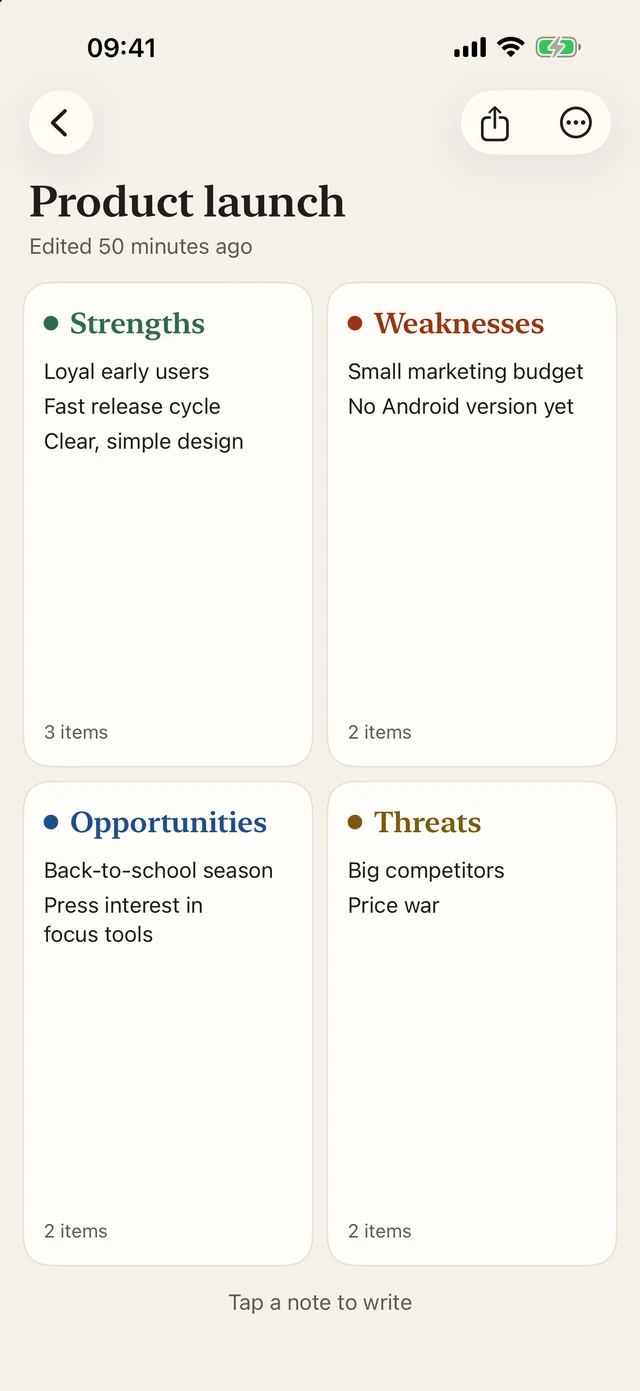
This template is waiting in Side Notes.
Create a board and pick “SWOT Analysis”: the note headings are already in place. Free on iPhone, iPad and Mac.
Free, no ads, no account.
Printable version
A blank grid, ready to fill in with a pen. The button prints the example and the blank grid, without the rest of the page.
SWOT analysis template · Blank grid
Strengths
Weaknesses
Opportunities
Threats
Frequently asked questions
What does SWOT stand for?
Strengths, Weaknesses, Opportunities and Threats. The first two are internal, the last two external.
What is the difference between a weakness and a threat?
A weakness is internal: you can act on it. A threat is external: you do not control it, you can only prepare for it.