Pros and cons list
Two columns, one clearer answer. A pros and cons list is the simplest way to weigh a decision: what speaks for it on one side, what speaks against it on the other, and both in view at the same time.
A filled-in example
Pros
- +25% salary
- Remote three days a week
- Modern tech stack
- Learning budget
- Closer to family
5 items
Cons
- Longer commute
- Six-month probation
- Leaving a great team
- Fewer vacation days
4 items
When to use it
For any decision with two outcomes: yes or no, stay or go, buy now or wait. The list will not decide for you. It makes visible what you already know, and shows what is missing.
- Taking a job offer or a promotion
- Moving, or buying a home
- Starting a project, going back to school
- A big purchase: a car, a laptop, a trip
How to fill it in
- Write the question as the title, in a yes or no form: “Take the job?”.
- Empty your head into both columns without sorting. One argument per line.
- Read the two columns against each other. Three small pros do not always outweigh one big con.
- Sleep on it, then read it again. Whatever still bothers you the next morning is often the real answer.
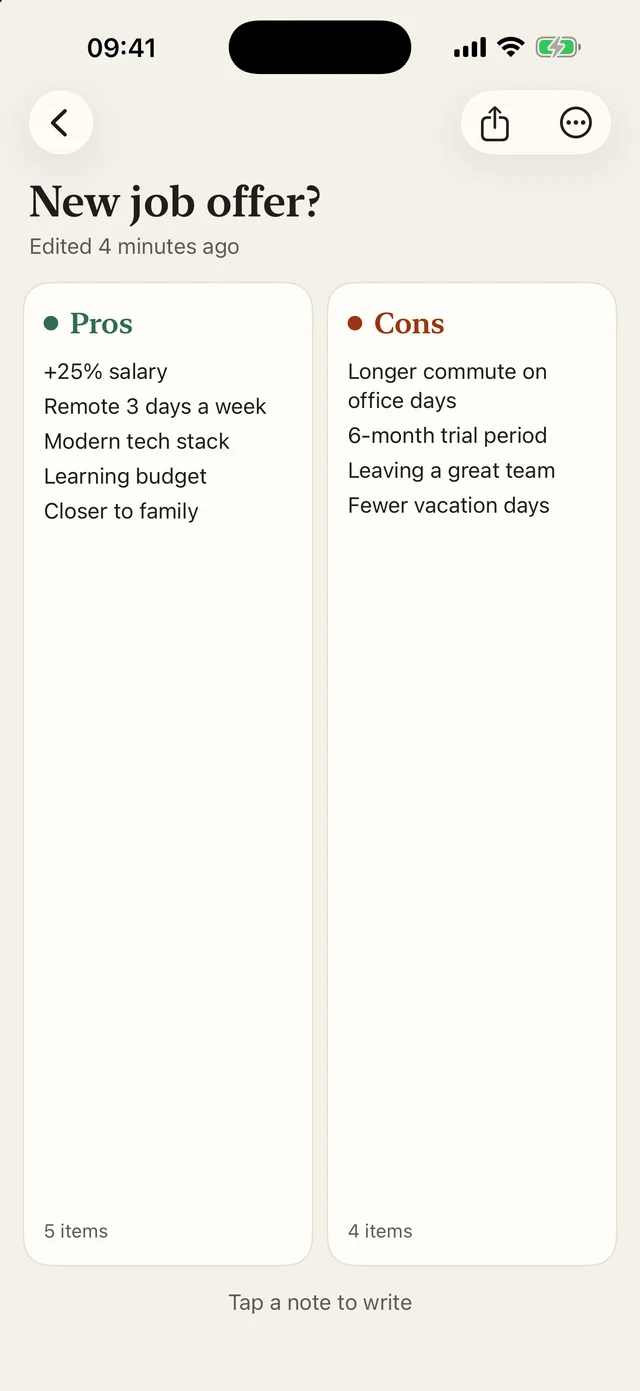
This template is waiting in Side Notes.
Create a board and pick “Pros & Cons”: the note headings are already in place. Free on iPhone, iPad and Mac.
Free, no ads, no account.
Printable version
A blank grid, ready to fill in with a pen. The button prints the example and the blank grid, without the rest of the page.
Pros and cons list · Blank grid
Pros
Cons
Frequently asked questions
How do you make a good pros and cons list?
Ask a yes or no question, write one argument per line, then weigh the arguments instead of counting them. Seeing both columns side by side helps you spot the ones that really matter.
Should I give each argument a weight?
You do not have to. Often it is enough to mark the two or three deciding arguments. If you want to score them, a scale from 1 to 3 is plenty.